How to achieve a perfect result with an airless pump
Exterior spray painting is a technical solution used more and more often when building or restoring façades. Derived from technologies long established in industrial and professional settings, this application method delivers uniform surfaces, shorter working times and optimal control over the final result compared with traditional methods.
To achieve high quality standards, however, spraying technique alone is not enough. The result depends on the balance between technology, material and operational setup – inseparable elements for achieving lasting performance, aesthetic quality and maximum efficiency.
Why choose spray painting for exteriors?
Aesthetic uniformity on façades
Exterior spray painting delivers continuous, homogeneous coverage, particularly effective on large or architecturally complex façades. Airless technology handles irregular, porous or textured surfaces (with corners, recesses or detailing, for example) with greater precision, reducing the thickness variations and lap marks typical of manual application. The result is a finish that enhances the building’s appearance and retains its aesthetic quality over time.
Application speed and productivity
Compared with traditional methods, spray application significantly reduces time on site. Continuous delivery and fast coverage boost productivity, making this solution particularly suitable for large surfaces and jobs that demand tight schedules.
Less waste, more control
Unlike compressed-air systems, airless technology limits material dispersion, improving spray control and application efficiency. This translates into more rational paint usage, greater precision and cleaner job sites.
Airless paint pumps: how they work
The airless principle (no compressed air)
In airless paint pumps, the material is atomised exclusively by hydraulic force, with no compressed air involved. The paint is drawn in and pushed at high pressure through the fluid circuit to the gun, where passing through the spray tip generates the spray. The absence of carrier air allows precise flow control and a uniform application of the material on the surface, regardless of its size or complexity. This approach clearly sets airless pumps apart from traditional systems, improving application performance and reliability.
Why airless technology reduces overspray
Airless technology ensures controlled deposition of the paint, since the material is projected towards the substrate without creating an uncontrolled mist. This drastically limits dispersion into the environment, with tangible benefits in economic terms – less wasted product – as well as for the environment and operator health. The result is a more efficient, cleaner process, fully aligned with the demands of professional exterior spray painting.
Exterior paints: which materials to use with an airless pump
Siloxane exterior paint: stable, durable bonding
Siloxane exterior paint is among the materials best suited to spray application on façades, thanks to a formulation that uses siloxanes as the main binder. These components react chemically with the mineral substrate, creating a stable, long-lasting bond that helps protect the surface over time.
One of the main advantages of siloxane paint is the combination of breathability and water repellency. The microporous structure of the dried film allows water vapour in the masonry to escape, preventing moisture build-up while simultaneously stopping rainwater from penetrating. This dual function is crucial in exterior applications, where surfaces are constantly exposed to rain, temperature swings and aggressive weathering.
From an application standpoint, siloxane paint works very well with airless technology because it allows a uniform coat even on irregular or slightly absorbent substrates. Its weather resistance and colour stability also help keep the façade’s appearance unchanged over the long term, reducing the need for maintenance work.
Acrylic-siloxane paint: performance and versatility
Acrylic-siloxane paint offers a middle ground between traditional acrylic paints and siloxane paints, combining the advantages of both in a single formulation. Blending acrylic resins with siloxane components achieves better adhesion to the substrate while maintaining good breathability and weather resistance.
This type of product delivers a uniform, stable aesthetic finish over time, making it ideal for repainting existing façades or surfaces that require a balance between protection and application flexibility. Acrylic-siloxane paints provide good coverage and an even finish, enhancing the architectural appearance of the building.
Operationally, acrylic-siloxane exterior paint is fully compatible with airless spray application. Its composition allows controlled, homogeneous coverage, making work on large surfaces easier and reducing the risk of unevenness or imperfections. This makes acrylic-siloxane paints a versatile choice for professionals seeking application reliability and quality results.
Quartz paints: mechanical resistance and textured finish
Quartz paints are formulations that contain quartz micro-granules within their composition. This mineral gives the product a slightly grainy consistency, increasing the mechanical resistance of the applied film and improving its ability to protect the façade from weathering and atmospheric stress.
Aesthetically, quartz paint helps create visually stronger, more compact surfaces, with a textured finish that enhances the building’s appearance and helps mask small substrate imperfections. As a film-forming water-based paint made from synthetic resins and water, it lends itself to uniform, high-coverage coats, particularly suited to harsh climates or damp areas.
The presence of mineral fillers does, however, make the material more abrasive than other exterior paints. That is why it is important to use airless pumps designed to work with filled products, paired with quality paints featuring fine particulate. A well-formulated product reduces wear on the most heavily stressed components and maintains delivery continuity and spray stability over time.
Siloxane paint and airless pumps: what to know before you start
To achieve optimal results with spray-applied siloxane exterior paint, start with product quality. Paints formulated with finer particulate promote uniform coverage and reduce mechanical stress on the equipment, helping maintain consistent performance over time.
Operationally, several parameters deserve careful attention. The viscosity of the material directly influences the choice of pump and tip, while the working pressure must be adjusted to suit the product and substrate, avoiding both excessive misting and irregular flow. Correct tip selection allows you to control flow rate and spray fan, improving finish quality and on-site productivity.
There is a direct link between the material used and the machine’s behaviour: choosing the right product means limiting abrasiveness, reducing component wear and exploiting the full potential of airless pumps, achieving reliable, repeatable application results.
Piston or diaphragm airless pump: understanding the difference to work better
Piston airless pumps are traditionally associated with handling heavily filled materials or coarser particle sizes. Their pumping system can develop very high pressures, suited to specific technical applications. However, this configuration involves greater mechanical complexity, with components subject to accelerated wear when working with abrasive products. The result is generally higher purchase and maintenance costs, plus more demanding equipment management – factors to weigh carefully in the construction sector.
Diaphragm airless pumps like those manufactured by Tecnover stand out instead for their high flow rates and operational continuity, even over extended work cycles. Far from being limited to light-duty work, they are widely used on demanding job sites and in intensive professional applications, including work on large exterior surfaces. Their reliability, combined with simpler maintenance and lower running costs, makes them fully suited to construction work and façade painting.
How to achieve a professional result with an airless pump
Substrate preparation
A professional result always starts with proper surface preparation. Dust, dirt, old paint residues or traces of moisture compromise material adhesion and the durability of the job: before spraying, it is essential to clean the substrate thoroughly and check that the ambient conditions are compatible with the product being used.
Tips and pressure
Tip selection and pressure adjustment directly affect application quality. Tips that are too large can cause excess material and runs; tips that are too small risk compromising coverage. The right tips combined with correct pressure deliver a uniform, controlled spray, tailored to the type of paint and the surface being treated.
Spraying technique
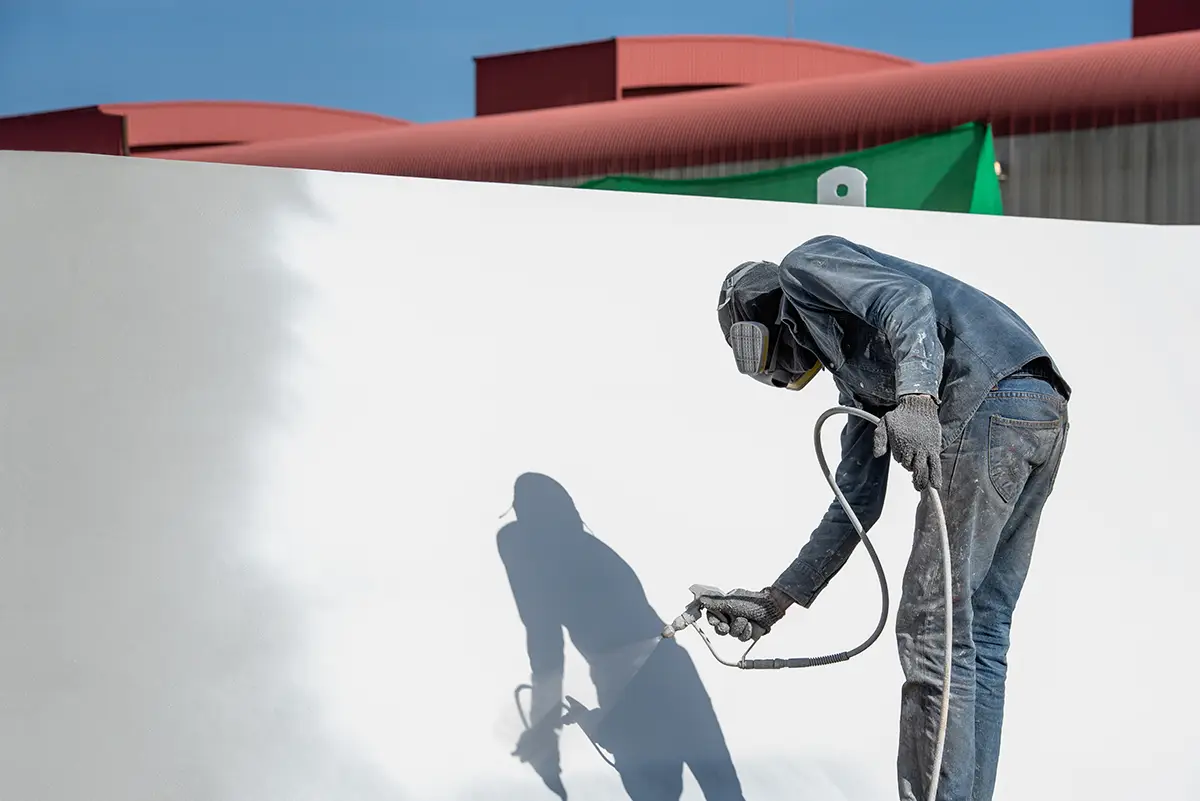
During application, hold the gun at a constant distance of around 30–40 cm from the surface. The movement should be straight and its speed steady. This technique distributes the material evenly, reducing imperfections and waste.
Cleaning and maintaining the airless pump
Airless pump cleaning must be carried out immediately after use, before the paint starts to dry inside the system. The first step is to spray the base fluid of the previously applied product, so as to flush out residues in the lines. The flushing procedure varies according to the material used: water-based paints require rinsing with clean water, while solvent-based products call for the appropriate thinner.
The cleaning fluid must pass through the entire circuit, ensuring that hoses, gun and filters are completely free of residue. Pay particular attention to the tips, which must be checked and cleaned with care, avoiding metal tools that could damage them. At the end of the day, it is good practice to dismantle the main components (such as filters, gun handle and tip) and rinse them thoroughly, to prevent encrustation and maintain consistent performance over time.
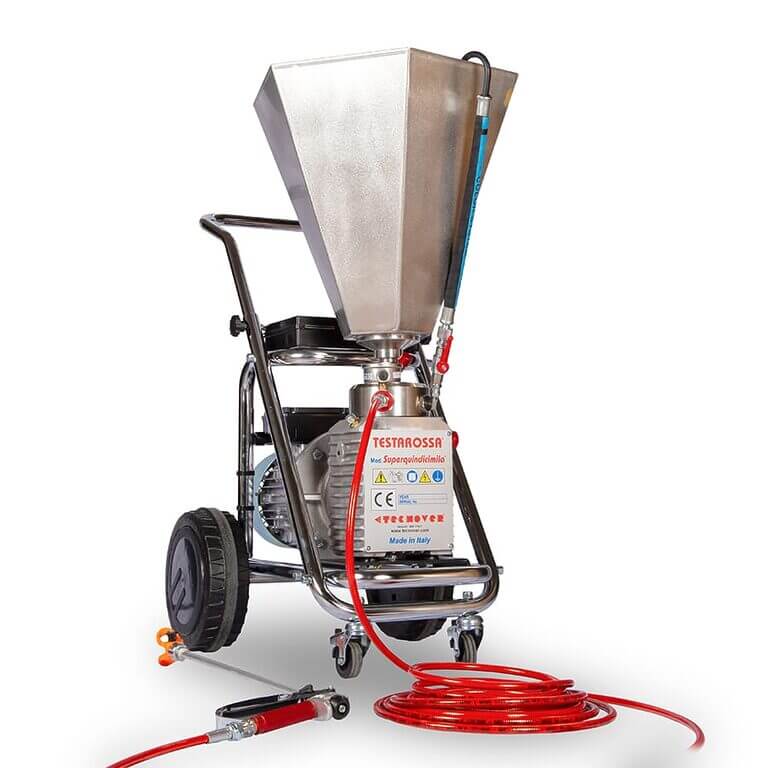
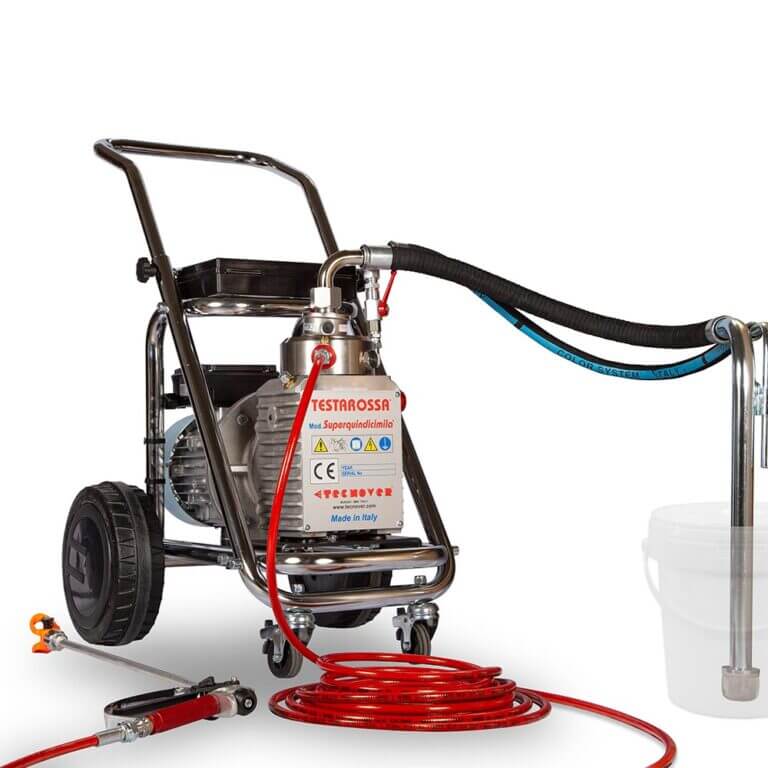
For applications on façades and large surfaces, Tecnover develops airless pumps engineered to deliver high flow rates, operational continuity and compatibility with siloxane and acrylic-siloxane paints, such as the Testarossa Superdiecimila and Superquindicimila models – both also available with a petrol engine – alongside innovative accessories such as the Revolver range.
Ask our experts for support to receive targeted technical advice and help choosing the solution best suited to your needs.