One of the main advantages guaranteed by an airless pump lies in its extraordinary versatility: this innovative work tool – by now an indispensable ally for professionals of all kinds, from construction workers to artisans – is useful not only for painting wood or metal or for decorating walls, but also for applications such as applying waterproofing membranes, coatings and intumescent paints, and for filler application (skim coating).
The days of applying filler by hand are long gone: thanks to airless pumps, this delicate operation can now be completed faster and more efficiently, with the added benefit of greater control and precision during the work.
To understand how an airless pump can be used for spray-applied filler and how best to proceed to achieve professional-grade results, let’s first take a step back and refresh a few basics about this specific process.
What is spray-applied filler?

Filler (skim coat) is a material commonly used to improve the appearance of raw surfaces made of concrete, metal, plasterboard and even wood. It is a compound available in different formulations depending on the application, and it can be blended with glass fibres or acrylic additives to make it more workable and durable.
It is also worth noting that filler application is generally the prelude to subsequent work on walls and ceilings – such as painting. This process therefore serves to prepare the substrate for later work, smoothing out imperfections, filling cracks and repairing any irregularities in the surfaces.
However, the purpose of filler application (whether sprayed or manual) is not purely aesthetic, but also functional: when spread evenly and correctly, filler acts as a base coat and ensures better adhesion for tiles or wallpaper, precisely because it produces a smooth surface free of imperfections and cracks. The typical silky-smooth walls, for example, are achieved through several applications of fine, paste-like filler, carefully sanded between coats.
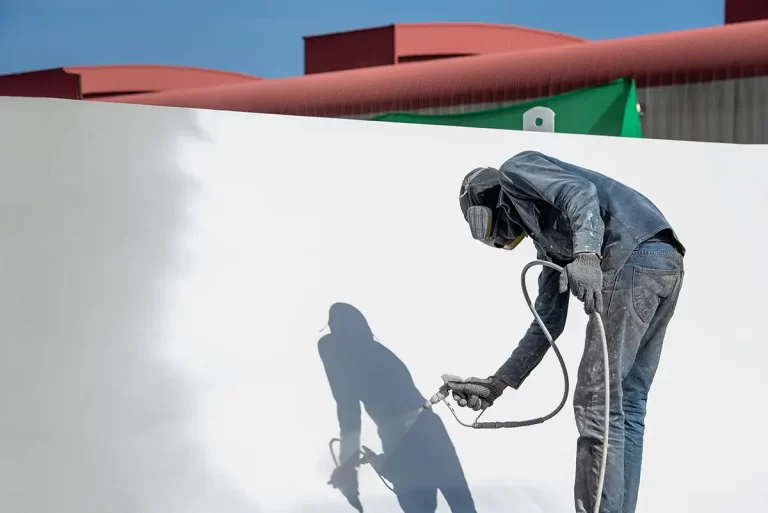
Spray-applied filler with an airless pump is the evolution of traditional manual application, a process that by its nature consumes both time and energy. Spray filler proves the right solution in many settings, particularly where very large surfaces need skimming, because it allows considerable savings in time and material.
As for the materials to use, they must of course be compatible with your device: airless fillers are compounds specially formulated for spray application and are therefore not suitable for manual use. Two good-quality examples are Knauf’s Super Finish and ItalCover’s Stucco Airless.
How is filler spray-applied with an airless pump?

In strictly operational terms, spray filler application with an airless pump follows a well-proven process made up of specific steps. As regards preliminary precautions, this type of work should preferably be carried out at room temperature, with a device fitted with the correct tip (see our selection guide!) and, of course, with the most suitable airless pump.
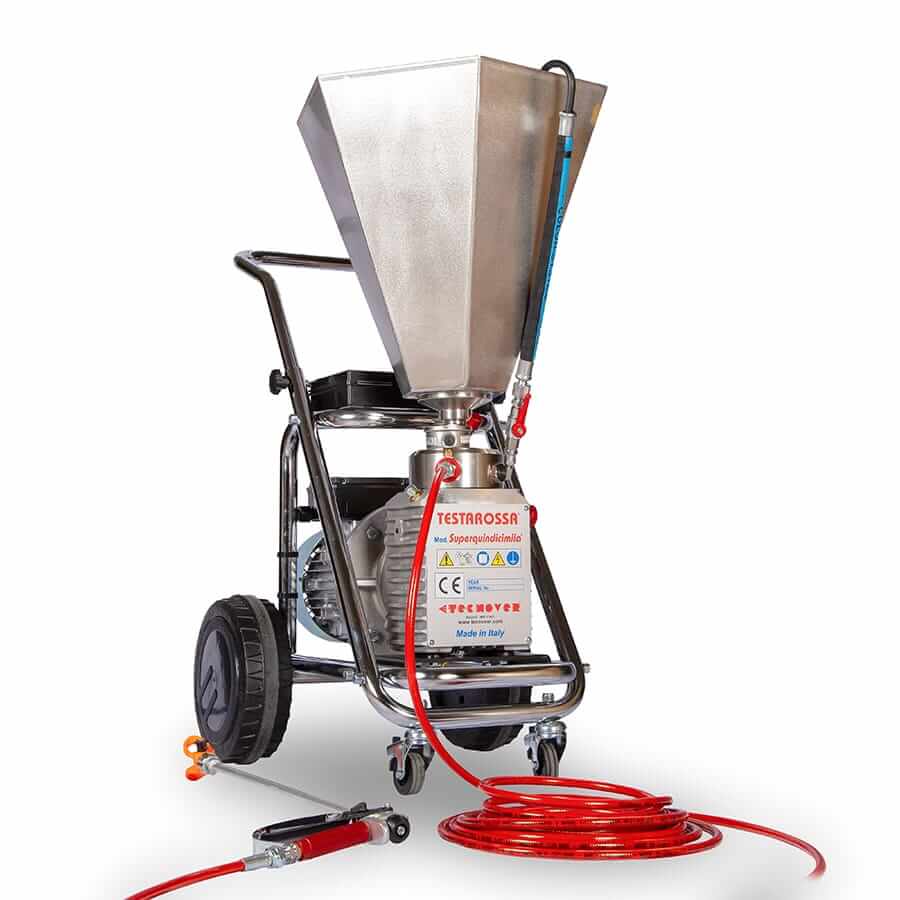
For spray filler work, Tecnover recommends the Testarossa Superquindicimila model: an extremely powerful airless pump designed for use on large surfaces. The filler application machine comes with a painting kit consisting of:
- 30-litre stainless steel gravity-feed hopper
- Fitting with pressure gauge
- Anti-vibration hose
- Single steel-braid high-pressure hose, ⅜″ diameter, WP 300 bar, 10 metres long
- Professional TECNOVER airless gun mod. B500
- 50 cm gun extension
- Base kit + TECNOVER Paintip Heavy Duty 0.021″ self-cleaning tip
Let’s now go through, step by step, the rules to follow for a correct spray filler job with an airless pump.
The very first operation is cleaning the surface to be skimmed, which involves careful removal of dirt and dust using brushes and sponges. Next comes the preparation of the filler and its loading into the airless pump: you can use either a pre-mixed airless filler (i.e. ready to use) or an airless filler in powder form (to be mixed beforehand, carefully following the manufacturer’s instructions).
We also recommend emptying the packs of filler needed for the project into a large container from which the material can be “drawn” more quickly to fill the pump’s hopper.
Once the material is ready, it is time to set the correct spraying pressure, which must be adjusted according to the viscosity of the chosen filler. Always remember that if the spraying pressure is too low, the spray will collapse. Conversely, excessive pressure will produce so-called “overspray”. Our advice is to test your airless sprayer on a small section of the surface to be skimmed to assess the quality of the spray.
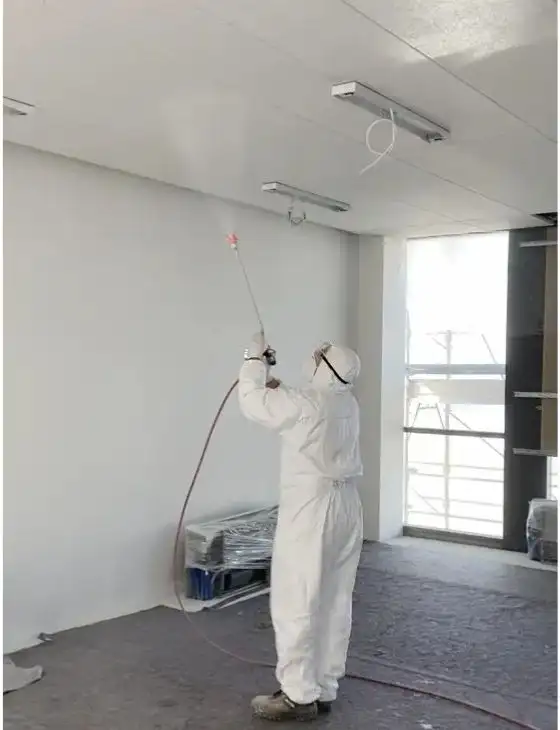
You are now ready for the actual spray application. For this type of process, avoid rotary movements and always keep the spray gun at the same distance from the surface: this makes the skim coat more homogeneous and even. If the application is done correctly, the wall will require little or no sanding, keeping this tiring operation – and the dust it creates – to a minimum, all to the benefit of a quicker, cleaner job. Precisely because of the “tight” timing of these operations, spray filler application with an airless pump should always be done by two people working together: the first prepares the compound, the second sprays it onto walls and ceilings.
At the end of the job, you must carry out proper cleaning of your airless pump, which must obviously be done before the filler solidifies. Simply fill the gravity-feed hopper with water and spray it back into the same container (recirculation) or into a collection basin, while to clean small parts such as the tip and the gun, dismantle them and soak them in plain hot water.
If you have any doubts about maintaining your airless pump, the Tecnover experts are always at your disposal.
The advantages of spray filler application with the Testarossa Superquindicimila airless pump
By choosing Tecnover’s Testarossa Superquindicimila airless pump, you can achieve a perfect, efficient spray filler application and work that is faster, more precise and less tiring.
The advantages of using our device for this type of application are numerous:
- Uniform, constant distribution of the compound across the entire surface
- Real time savings
- Less material waste, with resulting cost savings
- Maximum comfort, guaranteed by the operator’s upright working position
- Reduced physical effort, especially when applying to the lower sections of walls or to ceilings
- Wide working reach, making it easy to work on corners and hard-to-access areas
- Precise control of the applied material thickness
Once the spray filler application is finished, you can then move on to painting the walls with the same airless pump – even using two guns simultaneously, halving the execution time!
Would you like technical or sales support for your applications, or help choosing the perfect device or accessories for your needs? Get in touch with us!