Intumescent paint is a protective coating designed to increase the fire resistance of surfaces and structural elements. Its working principle is chemical and physical: when exposed to high temperatures, the paint reacts by expanding and transforming into an insulating carbonaceous char layer. This barrier slows the transmission of heat to the substrate, helping preserve its structural stability for a defined period of time.
Intumescent paint for steel is typically applied to beams, columns and load-bearing structures in industrial, commercial and residential buildings. There are, however, specific formulations for wood, concrete and gypsum as well, developed to provide passive fire protection without altering the geometry, appearance or functionality of the treated elements.
Amotherm is the line of intumescent paints developed by Amonn Color, a globally recognised brand specialising in certified protective systems for a range of materials. The range includes single-component water-based (WB) or solvent-based (SB) products, which can be applied with airless technology, roller or brush, certified to EN 13381-4 and holding a European ETA.
The brand’s flagship products include Amotherm Steel WB/SB, for protecting steel up to R120, Amotherm Wood WB/SB, dedicated to wood and wood-based materials, and Amotherm Concrete/Gyps WB for concrete and plasterboard. All formulations are thixotropic (meaning they become more fluid when stirred, then thicken or gel again once left to rest, without undergoing any chemical alteration), tested for impact, abrasion and humidity resistance and designed for controlled application.
Applying intumescent paint is a critical step: film thickness, uniformity and continuity directly affect the effectiveness of the system and the validity of the final certification. This means that even a high-quality product can see its performance compromised if applied without the necessary technical control.
Industrial coating vs decorative painting with intumescent paints: what’s the difference?
When talking about paints (intumescent or otherwise), the terms industrial coating and decorative painting are often used interchangeably, even though they refer to different operating contexts.
Industrial coating is typical of industrial settings and structural steelwork: workshop or factory processes, structural steel surfaces, controlled application cycles and high production rates. In these cases, the paint pump must guarantee continuity, precision and speed of execution.
Decorative painting, on the other hand, belongs to the world of construction and job sites, particularly in the residential sector: work on existing structures, interior or exterior environments, applications at height or in complex spaces. Here, the airless sprayer must offer manoeuvrability, film thickness control and adaptability to working conditions.
In both scenarios, the technical demands are the same: intumescent paint requires constant pressure, uniformity and repeatability. That is why the airless pump is regarded as a cross-cutting solution, suited to both industrial coating and residential painting.
Why choose an airless pump for intumescent paint
Intumescent paints are characterised by high viscosity and a special formulation that requires operating pressures above 200 bar to be atomised correctly.
As is well known, a professional airless pump works without compressed air: the material is pushed directly through the tip by hydraulic force alone. This drastically reduces overspray, limiting product dispersion into the environment and improving application efficiency. The result is greater film thickness uniformity – essential for guaranteeing the declared performance of the intumescent paint and compliance with design parameters.
Compared with the traditional roller or air-spray systems, the airless sprayer also offers markedly superior control over high-viscosity materials, ensuring homogeneous, fast and technically reliable application in both industrial and civil settings.
Technical requirements of an airless pump for intumescent paints
Not all equipment is suited to applying intumescent paints. To work correctly and continuously, we recommend a professional airless pump designed to handle high-viscosity materials and demanding application cycles.
The first requirement to consider is the operating pressure, which must sit stably between 200 and 250 bar. Only within this range can you guarantee uniform atomisation of the product, avoiding flow drops or irregularities in the applied thickness. Alongside this comes the need for a high, constant flow rate, essential above all when working on large surfaces or complex structures.
From a construction standpoint, a stainless steel pump head is a key feature: it ensures wear resistance, compatibility with abrasive products and greater longevity. Equally important is compatibility with tips up to 0.045″ in orifice diameter, indispensable for correctly handling dense paints without blockages.
Finally, the option of adding a gravity-feed hopper improves material feed, making the paint pump even more stable and efficient in intumescent applications.
Tecnover airless pumps for intumescent paints
In the field of high-viscosity paint application, Tecnover has been an established technical benchmark internationally for years. The company develops and manufactures its professional airless pumps entirely in Italy, engineered to handle complex jobs where delivery continuity, stable pressure and mechanical reliability are non-negotiable. Its specialisation in viscous materials – such as intumescent paints, fillers, waterproofing membranes and protective coatings – has driven targeted design solutions for intensive use in industry and construction.
Tecnover airless pumps also deliver maximum application control, long service life and compatibility with certified systems, particularly when working with intumescent paint for steel or on wood and cement substrates treated with specific products such as Amonn Amotherm.
Which Tecnover airless pump models for intumescent paint?
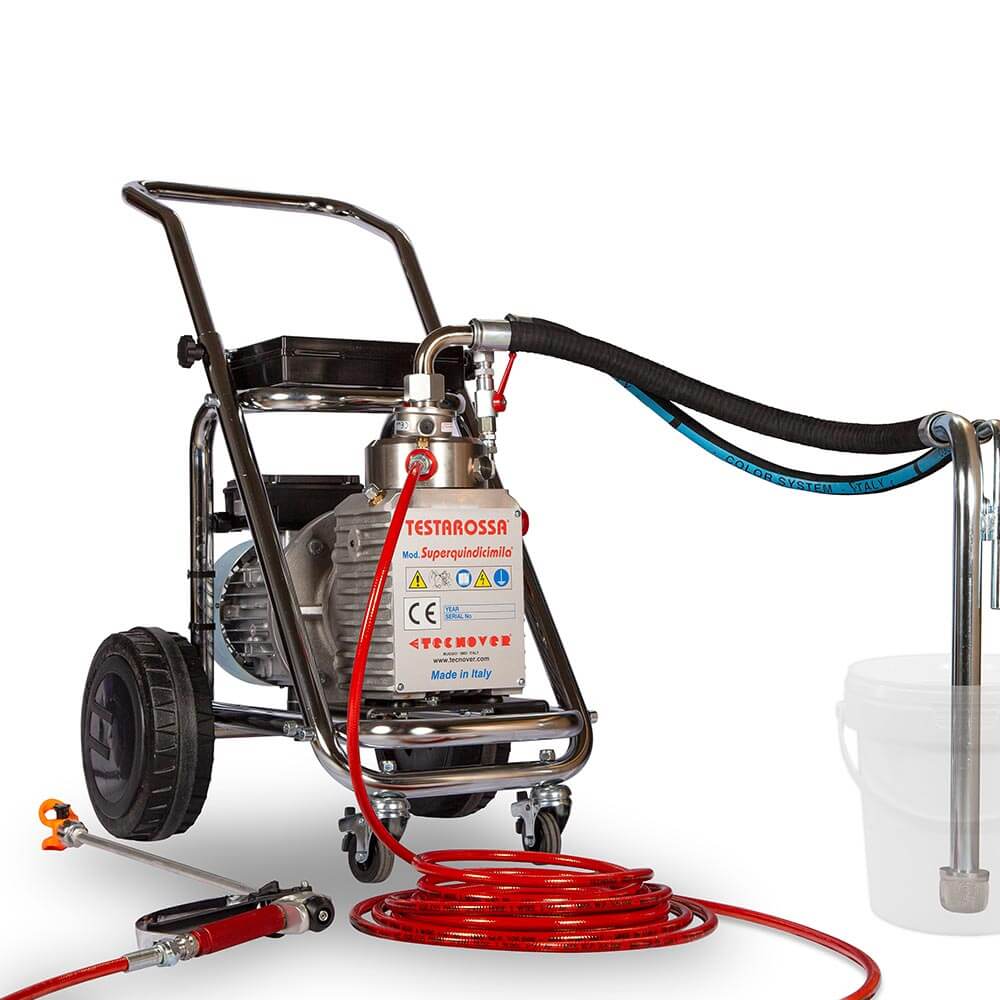
Among the solutions best suited to applying intumescent paints is the Testarossa Superquindicimila, the Tecnover airless pump designed to handle very dense materials continuously and efficiently. It works at pressures of up to 250 bar, guaranteeing uniform atomisation even with large-orifice tips, and is suitable for applying high-performance professional products such as Amotherm Steel and Amotherm Wood.
It offers a flow rate of 13 l/min and the ability to run with two operators simultaneously. This feature is particularly valuable on large job sites or in industrial work, where productivity and continuity are decisive.
In every case, Tecnover technology makes it possible to tackle intumescent paint application in a controlled, repeatable way, consistent with the technical specifications of Amotherm products and the relevant standards.
Spray settings: pressure, tips and configuration
For correct application of intumescent paint with an airless sprayer, the recommended pressure generally sits between 150 and 220 bar: good practice is to start at lower values and increase progressively until you achieve a stable, uniform spray, avoiding excessive misting or material waste. Correct pressure maintains flow continuity and control over the applied thickness.
The choice of tip is just as important. For most intumescent paints, tips with an orifice between 0.021″ and 0.031″ are used, while for particularly dense or filled products you can go up to 0.045″, always checking compatibility with the pump. An undersized tip can cause clogging and interruptions, while an oversized one reduces control during application.
During application, a 50% overlap between passes is recommended to guarantee film uniformity and continuity. The configuration is completed by suitable filters and a ⅜″ high-pressure hose, essential for maintaining delivery stability and operational safety.
Maintaining the airless pump after using intumescent paints
After applying intumescent paints, maintenance of the professional airless pump is essential to preserve its performance and service life: these products tend to leave dense residues which, if not removed promptly, can cause clogging and premature component wear.
Cleaning must be carried out immediately, i.e. as soon as the job is finished. With water-based intumescent paints, circulating clean water through the circuit until the product is completely removed will suffice. For solvent-based formulations, the compatible thinner specified by the manufacturer must be used.
Using original maintenance kits – filters, seals and dedicated components – keeps the system efficient and reduces the risk of leaks or pressure drops. What’s more, regular maintenance not only prevents clogging and wear, but also ensures the airless pump is always ready for the next application, keeping spray quality consistent.
In conclusion, applying intumescent paint leaves no room for approximation. Guaranteeing the declared performance and meeting regulatory requirements always demands precision, continuity and control at every stage of the job. In this context, the airless pump is an integral part of the application system, since it makes it possible to handle high-viscosity materials correctly, maintain thickness uniformity and deliver repeatable, quality results.
Thanks to the experience built up over the years and its specialisation in complex technical applications, Tecnover is the technical partner of choice for professionals and companies working in passive fire protection as well. To identify the configuration best suited to your intumescent application, you can contact the Tecnover team and request a dedicated application consultation.