Differences, advantages and applications
Choosing between a diaphragm airless pump and a piston airless pump depends on the type of material you need to spray, the surface to be coated, the productivity required and how the equipment will be managed over time.
Both technologies work on the airless principle: the material is drawn in, pressurised and pushed towards the spray tip, where it is atomised without the use of compressed air. What changes is the system the pump uses to generate pressure and keep the flow steady during application.
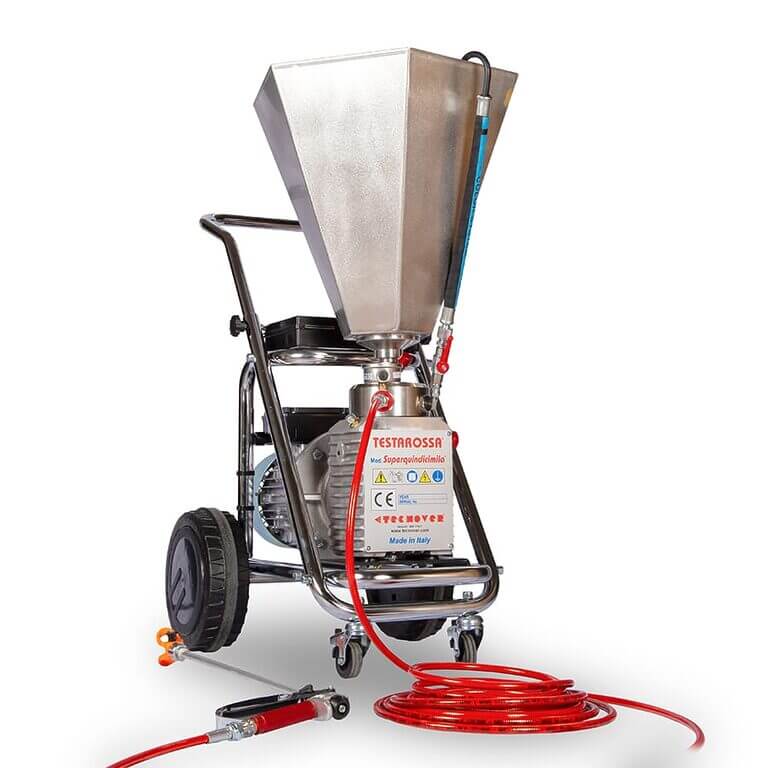
Tecnover airless pumps – available in both electric and petrol-driven versions – are all diaphragm pumps, engineered for professional use, with models suited to wall paints, enamels, technical coatings, quartz-filled paints, speciality paints, resins, high-build products and large-surface applications.
How an airless pump works
Come accennato, la pompa Airless si chiama in questo modo perché eroga il materiale ad alta pressione, senza As mentioned, an airless pump takes its name from the fact that it delivers the material at high pressure, without compressed air. The paint or coating is drawn from its container, pushed through the fluid circuit and fed to the spray gun. As it passes through the spray tip, the material is turned into a controlled spray governed by three key factors: pressure, flow rate and tip orifice size.
- Pressure determines the pump’s ability to atomise the product.
- Flow rate determines the amount of material delivered.
- The choice of spray tip defines the fan width and the volume of product applied to the surface.
To achieve a consistent finish, these parameters must work together: if the pressure is too low, the spray pattern may become irregular; an unsuitable tip can cause build-up, clogging or uneven coverage. That is why the choice of airless sprayer is closely tied to the material, the substrate and the expected pace of work.
Piston airless pump: technical characteristics
A piston airless pump uses the reciprocating movement of a piston inside a cylinder to draw in and pressurise the material. This technology is traditionally associated with applications that demand high driving force, especially with high-viscosity or heavily filled products.
Piston pumps are indeed useful when the material is very thick, heavily loaded or difficult to move through the fluid circuit. That said, the evolution of construction materials has significantly improved the workability of many products: today it is far less common for high viscosity and coarse particle size to be so dominant that a high-output piston pump becomes a necessity.
Particle size also deserves careful consideration. A material with large particles may be technically sprayable with a high-performance piston pump, but spraying is not always the most cost-effective choice. If the product contains a large amount of grit or aggregate, that component will often be highly abrasive: this can shorten maintenance intervals, accelerate machine wear and drive up running costs.
From an operational standpoint, a piston configuration therefore calls for a careful, realistic assessment: pressure, viscosity, particle size, abrasiveness, spare parts, service support and potential machine downtime all need to be weighed up before deciding.
Diaphragm airless pump: technical characteristics
A diaphragm airless pump generates pressure through the controlled flexing of a flexible diaphragm. The diaphragm’s movement draws in the material and pushes it into the airless circuit, maintaining a steady, consistent delivery throughout the application.
This technology is highly valued for its smoother, more predictable operation and for maintenance that is generally simpler. In professional models such as those in the Tecnover range, the diaphragm airless pump offers high flow rates, operational continuity and a stable spray pattern, even over extended work cycles.
One point is worth making clear: a professional diaphragm airless pump should not be associated with light-duty work only! When correctly sized, it can handle demanding job sites too – façades, large surfaces and the application of viscous materials such as intumescent (fire-retardant) paints.
Here is a practical example in the video below: our Testarossa Superdiecimila at work spray-applying a polyurethane finish at the Port of Durrës.
All Tecnover airless pumps belong to the diaphragm pump category. The range has been developed to meet a wide variety of needs, from professional decorating through to the application of technical coatings, quartz paints, waterproofing products, resins and high-viscosity materials, depending on the model chosen and the correct working setup.
For quick reference, the table below summarises the main differences between diaphragm and piston airless pumps, helping you assess the most suitable technology based on material, application and day-to-day management.
| Factor | Diaphragm airless pump | Piston airless pump |
|---|---|---|
| Pumping system | Flexible diaphragm generating pressure | Reciprocating piston inside a cylinder |
| Day-to-day operation | Simpler and smoother | More complex, especially with abrasive products |
| Maintenance | Generally easier | More demanding, with wear-prone components |
| Applications | Paints, enamels, coatings, including dense materials on professional machines | Very viscous or heavily filled materials in specific applications |
| Work continuity | High on professional models | High, but with closer attention to maintenance |
| Versatility | High, especially on professional, correctly accessorised models | More limited, particularly for finishing work with light materials |
| Running costs | Generally lower | Generally higher |
| Selection criteria | Flow rate, pressure, tip size, viscosity and work cycle | Required pressure, material and intensity of use |
As you can see, the pumping technology is only one of the factors to consider. A high-performing airless sprayer should be chosen on the basis of practical parameters: the material to be applied, particle size, viscosity, surface, expected productivity and compatible accessories.
Which pump to choose based on the material to be sprayed
Choosing a pump always starts with the material. Wall paints, enamels, protective coatings, quartz paints and resins all behave differently inside the airless circuit. It is therefore essential to assess viscosity, particle size, abrasiveness and the type of finish required before choosing between a diaphragm and a piston airless pump.
Wall paints, enamels and medium-viscosity materials
With fluid or medium-viscosity paints, the main goal is a uniform spray pattern, the result of well-adjusted pressure and a spray tip suited to the type of finish. In these applications, what matters most is flow consistency, fan control and the pump’s ability to maintain steady output throughout the job. For enamels, finishing products and work on finer surfaces, the machine must allow progressive adjustment. An oversized or inflexible pump makes the spray harder to control, especially when working with small quantities of product or on jobs demanding greater precision.
Quartz paints, waterproofing products and technical coatings
With denser or filled materials such as quartz paints, waterproofing membranes or technical coatings, flow rate, tip orifice, filtration and wear resistance become critical. The pump must sustain the passage of the material without any drop in delivery, especially over large surfaces or long application cycles.
Particle size, filtration and delivery continuity
The particle size of the material also needs careful attention. A product with larger particles requires adequate clearance and compatible filtration to reduce the risk of clogging. In these cases, the airless pump must run continuously and keep the spray consistent throughout the application.
Machine, hose, gun and tip: assess the system as a whole
The choice between a diaphragm and a piston airless pump should be based on the complete system configuration: machine, hose, gun, filter, tip and material to be applied. Only the right balance between these elements guarantees productivity and finish quality.
Tecnover electric diaphragm airless pumps for professional use
Tecnover electric diaphragm airless pumps – such as the Testarossa Superdiecimila (also available in a flanged version), the Testarossa Superquindicimila, the Testarossa Superventimila and the Marine M12 – are developed for professional applications in construction, steelwork, joinery, industry and the marine sector, including complex job sites and large surfaces.
The extensive Tecnover range lets you choose your machine on the basis of measurable parameters: maximum pressure, flow rate, material viscosity, compatible tip orifice and the type of product to be applied. This approach helps operators avoid undersized machines or setups poorly matched to real-world work.
On site, a professional diaphragm airless pump delivers tangible benefits: continuous application, simpler machine management, strong productivity and faster maintenance. These are factors not to be underestimated when working on façades, exterior walls, large surfaces or systems requiring several coats.
Depending on the model, Tecnover pumps can be used with interior and exterior paints, enamels, quartz paints, coatings and more technical products. The final choice should always weigh up material, surface, tip and intensity of use.
When to opt for a diaphragm airless pump
A diaphragm airless pump is the best option when you need productivity, work continuity and practical, hassle-free equipment management. In professional models, this technology can tackle demanding applications while maintaining an excellent balance between performance and maintenance.
For building contractors, professional applicators and maintenance teams, the diaphragm pump offers a significant operational advantage: it allows you to work at a steady pace, keeping mechanical complexity to a minimum and simplifying end-of-job cleaning.
When to consider a piston airless pump
A piston airless pump may be worth considering for specific applications where the material demands very high pressures and intense driving force. This is the case with certain particularly viscous or heavily filled products, where piston technology has traditionally been the go-to option.
The decision must, however, also account for long-term management. With abrasive materials or frequent work cycles, component wear, spare parts, maintenance and downtime costs become decisive factors.
Another aspect is versatility: while they perform well with certain products, high-output piston pumps are less suited to finishing work with light materials or on more delicate surfaces. Their technology tends to produce harder pulses, which lend themselves less well to applications requiring fine control and progressive adjustment.
In professional applications, a high-quality diaphragm airless pump – such as the Tecnover models – delivers the required performance with far simpler management.
The golden rules for choosing the right airless pump
Before choosing an airless pump, it is worth checking a few technical parameters.
The viscosity of the material indicates how thick the product is and how much “effort” is needed to draw it in and spray it. Particle size affects the choice of filter and tip. The maximum pressure must guarantee a consistent spray, while the flow rate determines productivity on larger surfaces.
The maximum compatible tip orifice is also an essential figure, particularly with denser materials, since a suitable tip allows you to control fan width, coverage and the amount of product applied.
Filtration protects the pump, hose and gun, reducing lumps and clogging. Finally, cleaning should be carried out after every use: the fluid circuit, filters, gun and tip must be cleared of residue before the material begins to dry.
Since the right choice comes from reading all of these factors together, expert technical support can make all the difference, especially when working with specific materials or demanding site conditions.
The Tecnover experts will be glad to help you choose the machine, tip and accessories best suited to your needs: contact us today for a free, no-obligation consultation!