Airless pumps are high-tech pieces of work equipment that use high pressure to atomise/spray the product onto the surface to be treated. The term “airless” refers to the fact that these pumps rely exclusively on the pressure of the material, which is conveyed by the feed pump to the spray tip at the end of the gun in order to be atomised onto the substrate.
Precisely because of this characteristic, it is worth knowing the many types of material that can be used with airless pumps.
The products an airless pump can spray
The airless pumps from TECNOVER – a leading manufacturer and supplier of machines and systems for every spray painting need – are advanced, versatile systems that can be used in the most diverse fields. It is exactly this typical application flexibility of these machines – excellent across all manner of joinery, steelwork, construction and marine work – that ensures they can superbly atomise a wide range of materials.
Among the main ones:
- Enamels: protective finishes that create a hard, glossy, resistant “film” on the substrate’s surface. They can be water-based or solvent-based, and offer additional protection against wear, abrasion, corrosion and moisture penetration. Enamels are widely used to improve the appearance and durability of treated surfaces.
- Paints and coatings: generically speaking, products containing pigments and resins that harden after application, forming a protective layer on the treated surface. Various types of paint are available on the market, to be selected according to the material being treated and the specific application requirements.
- Anti-rust paints: surface treatments containing specific agents designed to prevent rust from forming on metal substrates. Their formulation typically includes zinc, phosphates or other corrosion inhibitors.
- Primers: preparatory coats applied to the substrate before the actual painting stage. Their purpose is to improve adhesion and protect the underlying surface. Applying primer creates a uniform, smooth surface that helps achieve a consistent, high-quality finish.
- Washable paints: paints with high water resistance and, consequently, very easy to clean and maintain. They are often used in construction work in environments subject to wear or high humidity.
- Distempers: water-based paints containing special coloured pigments or chemical binders. They are commonly used for decorative painting in construction or joinery work.
- Siloxane paints: siloxane-based paints offering excellent resistance to mould formation and weathering. For this reason, they are applied above all on exterior surfaces.
- Quartz paints: film-forming water-based paints containing quartz micro-granules, synthetic resins and water. Applied to the surface, they create a homogeneous layer that easily covers any cracks or imperfections in the substrate. They are notable for their high resistance to abrasion, mechanical stress and mould – so much so that they are used in construction for buildings located in damp areas.
- Epoxy resins: thermosetting polymers used as protective coatings or adhesives thanks to their high chemical and mechanical resistance. They are called “thermosetting” because they can be transformed from a liquid or malleable state to a solid state through an irreversible chemical curing reaction.
- Asbestos encapsulants: specific products formulated to contain or stabilise asbestos fibres, effectively reducing the risk of exposure to this dangerous material. They are applied directly to asbestos-containing surfaces such as insulation layers, tiles, pipes or roofing. Asbestos encapsulants fall into two categories: penetrating and coating types. Penetrating encapsulants are so named because they penetrate the treated surface and bind the asbestos fibres to the matrix containing them: their use is preparatory to subsequent asbestos removal. Coating encapsulants, on the other hand, create a tough membrane on the surface that locks the asbestos fibres inside it: these “films” are used for conservative interventions, i.e. those that do not involve removing the asbestos-containing structure.
- Two-component (2K) products: paints made up of two separate parts that must be mixed together before application. This process guarantees complete polymerisation and, consequently, high film resistance once applied to the substrate.
Airless pumps: ideal for atomising high-viscosity materials too
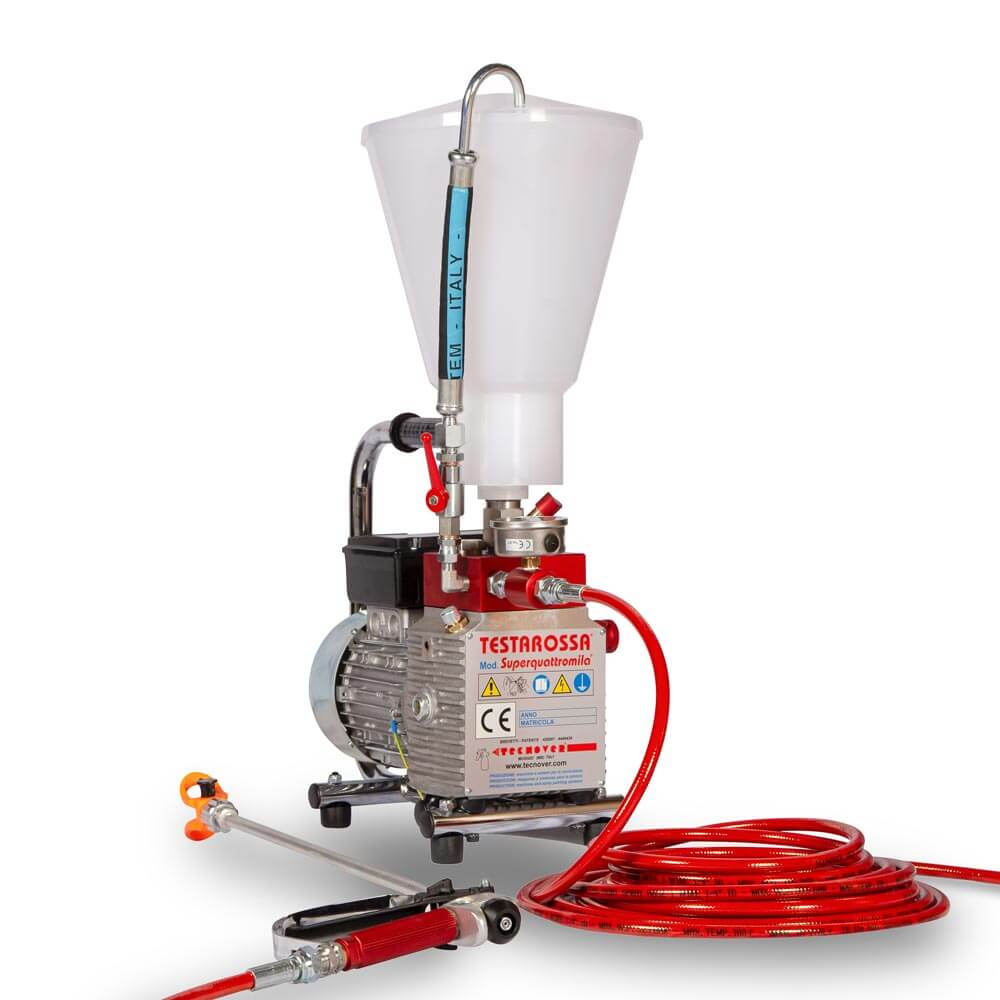
When equipped with the correct equipment and accessories (such as the 30-litre gravity-feed hopper that pairs with our Testarossa Superquindicimila), airless pumps can also flawlessly atomise high-viscosity materials such as:
- Spray fillers: also known as airless fillers, these are ready-to-use gypsum-based skim fillers for walls, specially formulated for “airless” application. Usable on interior walls, they do not sag, are self-levelling, easy to sand and quick-drying. To be applied, the product simply needs to be homogenised before use. Application on the substrate involves two or more coats depending on requirements, in some cases using tips with different orifices. Airless filler is suitable for cement- or gypsum-based civil renders or plasterboard, to level and even out any undulations in the surfaces.
- Liquid waterproofing membranes: liquid coatings used to create an effective barrier against water and moisture on various surfaces. They must be applied uniformly to the desired surface until they form a continuous seal that protects against water infiltration, damp and aggressive weathering agents such as rain, wind and ultraviolet rays. They come in various formulations based on polymers, resins, modified bitumen, silicone rubber, polyurethane, acrylic and other materials. For spray waterproofing, airless pumps prove by far the most effective solution.
- Epoxy resins: widely used in construction, these are thermosetting polymers containing epoxy groups. They typically consist of two components: the resin and the hardener. When these two components are mixed together, a chemical reaction occurs, producing a solid, durable material. Epoxy resins are renowned for their excellent mechanical strength, adhesion and chemical resistance. These properties make them suitable for a wide range of construction applications, such as structural reinforcement, concrete repair, waterproofing, industrial flooring finishes and protective coatings.
- Intumescent paints: paints formulated to swell and form an insulating layer when exposed to heat, thereby protecting the underlying structure. They are essential where the structural integrity of buildings must be maintained and enough time guaranteed for occupants to evacuate safely. Applying intumescent paints with airless pumps is one of the most frequent operations in construction.
Finally, it is worth remembering that the TECNOVER Marine M12 airless pump is specifically designed to meet the complex demands of the marine sector, as it can be used to apply special products such as:
- Antifouling paints: specific types of coating designed to protect submerged surfaces – such as boat hulls, vessel bottoms, jetties, buoys and underwater structures – from the build-up of algae, marine fouling and aquatic organisms. They are formulated to prevent or limit the growth of marine organisms on treated surfaces and generally contain chemical or biocidal substances for exactly this purpose (such as copper-based compounds, zinc, titanium dioxide, tributyltin and other specific formulations for long-term protection).
- Gelcoat: a special pigmented epoxy resin, usually used as a surface coating on composite materials such as carbon fibre and fibreglass for maritime/naval use, to improve their protection and appearance.
- Marine-grade epoxy resins: specific epoxy resin formulations designed to withstand the harsh conditions typical of the marine environment, such as salt, humidity and exposure to the elements.
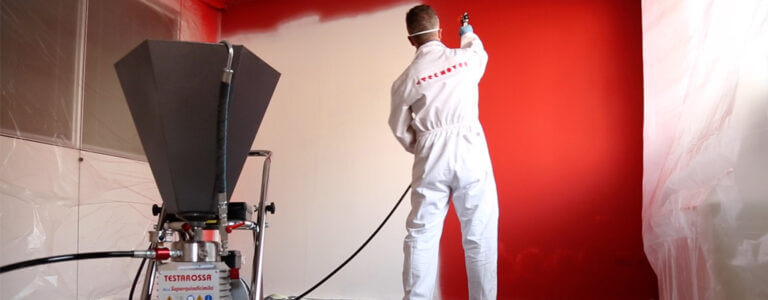
For all these materials, TECNOVER airless pumps deliver high-yield, mist-free painting: the material is sent at high pressure to the gun and its tungsten carbide tip. Thanks to the pressure drop as the product exits the tip, the material is atomised, reaching the surface to be painted at low velocity. Since product bounce-back is kept to a minimum by the absence of carrier air, overspray is essentially close to zero.
The main advantages of airless painting are easy to see: extremely high yield, with no product dispersion; fast application; and a healthier working environment (operators’ health benefits from the absence of mist formation).
Visit the page dedicated to TECNOVER airless pumps to find the model best suited to your specific application, or get in touch with our experts for assistance.