indice
Exterior quartz paint has a more viscous consistency than most emulsion wall paints and contains mineral fillers that put the pump, filtration system and spray tip under stress. To apply it uniformly on exterior substrates and achieve genuine “job-site productivity”, you need a professional airless pump capable of working at a stable pressure while correctly managing abrasiveness, filtration and the spray tip.
In this guide you will find practical criteria for choosing the right pump: pressure and flow rate relative to the surface, tip compatibility, filtration systems to reduce lumps and clogging, wear resistance of components, and maintenance guidelines to preserve performance over time.
Quartz paint can also be spray-applied: with the correct setup (well-prepared material, suitable filter, tip matched to the particle size and properly adjusted pressure) and a few best practices, you will achieve a uniform finish on façades and exterior walls, even on rough or irregular substrates.
Exterior quartz paint: how it differs from a “standard” paint
Quartz paint is a film-forming water-based paint whose formulation includes quartz particles/minerals (micro-granules). This component gives the finish a more textured, three-dimensional look, together with greater resistance to the stresses typical of exterior surfaces: weathering, abrasion and mechanical wear. That is why it is frequently chosen for façades and exterior walls, especially in exposed or damp environments.
From an application standpoint, the presence of fillers and the higher viscosity demand extra care in choosing the equipment. Otherwise, the most common operational risks increase: clogging, loss of output, accelerated wear of the most heavily stressed parts and a less uniform finish.
Finally, the quality of the product itself also affects the job: formulations with finer particulate flow more smoothly and help reduce blockages and maintenance interventions, with real benefits in terms of application continuity and running costs over time.
Can quartz paint be spray-applied?
Yes: quartz paint can be spray-applied.
This is a particularly smart choice when working on façades and large surfaces, because airless technology boosts on-site productivity and delivers a uniform coat, with good continuity even on rough or porous substrates. Using a suitable pump combined with a coherent setup (well-mixed material, correct filtration and a suitable tip) makes the painting process easier and significantly reduces application times, while delivering an optimal result even on irregular substrates or hard-to-reach areas.
Which technology to choose: piston or diaphragm airless pump
The functional difference
Piston airless pumps are traditionally associated with handling heavily filled materials or coarser particle sizes. Their pumping system can develop very high pressures, suited to specific technical applications. However, this configuration involves greater mechanical complexity, with components subject to accelerated wear when working with abrasive products. The result is generally higher purchase and maintenance costs, plus more demanding equipment management – factors to weigh carefully in the construction sector.
Diaphragm airless pumps such as those manufactured by Tecnover stand out instead for their high flow rates and operational continuity, even over extended work cycles. Far from being limited to light-duty work, they are widely used on demanding job sites and in intensive professional applications, including work on large exterior surfaces. Their reliability, combined with simpler maintenance and lower running costs, makes them fully suited to construction work and façade painting.
Which is best for quartz paint
With quartz paint, the goal is to maintain continuous delivery and stable pressure while working with a dense, viscous material. A professional diaphragm airless pump can handle extended exterior work cycles with more straightforward equipment management, especially when setup and maintenance are matched to the material.
In practice, three factors matter most:
- Operational continuity and flow rate, relative to the surface area and site schedule.
- Tip + filtration configuration, to reduce clogging and achieve a consistent finish even on rough substrates.
- Wear management and maintenance, central concerns when applying more viscous products like quartz paints.
Decision criteria: what to assess before choosing the pump
Pressure (and pressure stability)
With quartz paint, pressure is what delivers correct atomisation and a uniform coat. What matters most is stability: a steady pressure keeps the spray fan consistent, reduces finish variations and helps you work continuously on large surfaces, even when the material is dense.
Flow rate (l/min) and productivity on façades
Flow rate has a direct impact on site schedules. On façades and large surfaces, an adequate flow rate lets you keep a steady work pace, limiting stops and restarts. When choosing, think in practical terms: surface to cover + number of coats + weather window define the productivity required, and therefore the most appropriate equipment.
Compatible tips and orifice management
With “loaded” products like quartz paints, the tip should be chosen according to two factors: particle clearance and the desired aesthetic result. The orifice must match the particle size and the intended texture, while the fan width should be selected according to the geometry of the façade and the working distance. The pump’s compatibility with appropriate tips is a key criterion for avoiding output drops and clogging.
Filtration: how to reduce lumps and clogging
Filtration protects the pump, hose and tip, and keeps the application steady. With quartz paints, it is important to use a filtration system matched to the material and to follow a few best practices: thorough mixing, checking for lumps and proper management of the product in the drum. Where heavy particulate is present, elastic paint filter socks provide effective pre-filtering.
Resistance to abrasion and wear (components)
Quartz paint is harder on mechanical components because it contains mineral fillers. When choosing, it therefore pays to consider the pump’s build quality and the quality of the most heavily stressed components, so as to maintain operational continuity and limit unscheduled maintenance. In practice: the more intensive the cycle and the larger the surface, the more weight this criterion carries. To deliver maximum wear resistance with this type of material, all Tecnover airless pumps feature stainless steel valves with tungsten carbide seats – a material as hard as diamond.
Hose management, working distance and application control
The hose and gun influence output just as much as the airless pump itself. The length and diameter of the hose affect handling and flow regularity, especially on scaffolding and tall façades. The working distance and fan management also determine control, uniformity and the risk of build-up: a well-configured setup improves operator comfort and finish quality.
Maintenance and cleaning: what changes with viscous products
With particularly viscous products like quartz paints, maintenance must be treated as part of the process. The end-of-day routine is aimed at preventing deposits and blockages: a complete flush, cleaning of filters and tip, and inspection of the most wear-prone components. Careful maintenance reduces downtime and material waste, preserves performance and makes running times and costs more predictable, especially on exterior jobs with long cycles.
Exterior working setup: substrate preparation and spray application
Preparing the façade (substrate, roughness, absorption)
Before spraying quartz paint, check three things: cleanliness, substrate cohesion and absorption. Dust, friable areas, surface residues or dirt can compromise adhesion and finish uniformity. Where necessary, carry out localised repairs (micro-cracks, chalking spots, damaged areas) to make the surface homogeneous. On highly absorbent or irregular substrates, a suitable primer/sealer helps stabilise the base and improve application consistency.
Preparing the material (mixing, dilution if required, filtering)
Quartz paint must be brought to working condition through prior, thorough mixing, so the fillers are evenly distributed and lump formation is reduced. If specified by the manufacturer, any dilution should be managed carefully and kept consistent between refills, so as not to alter coverage or texture. For spraying, filtration (matched to the material and the chosen tip) helps maintain delivery continuity and limit clogging.
Spraying technique on exteriors
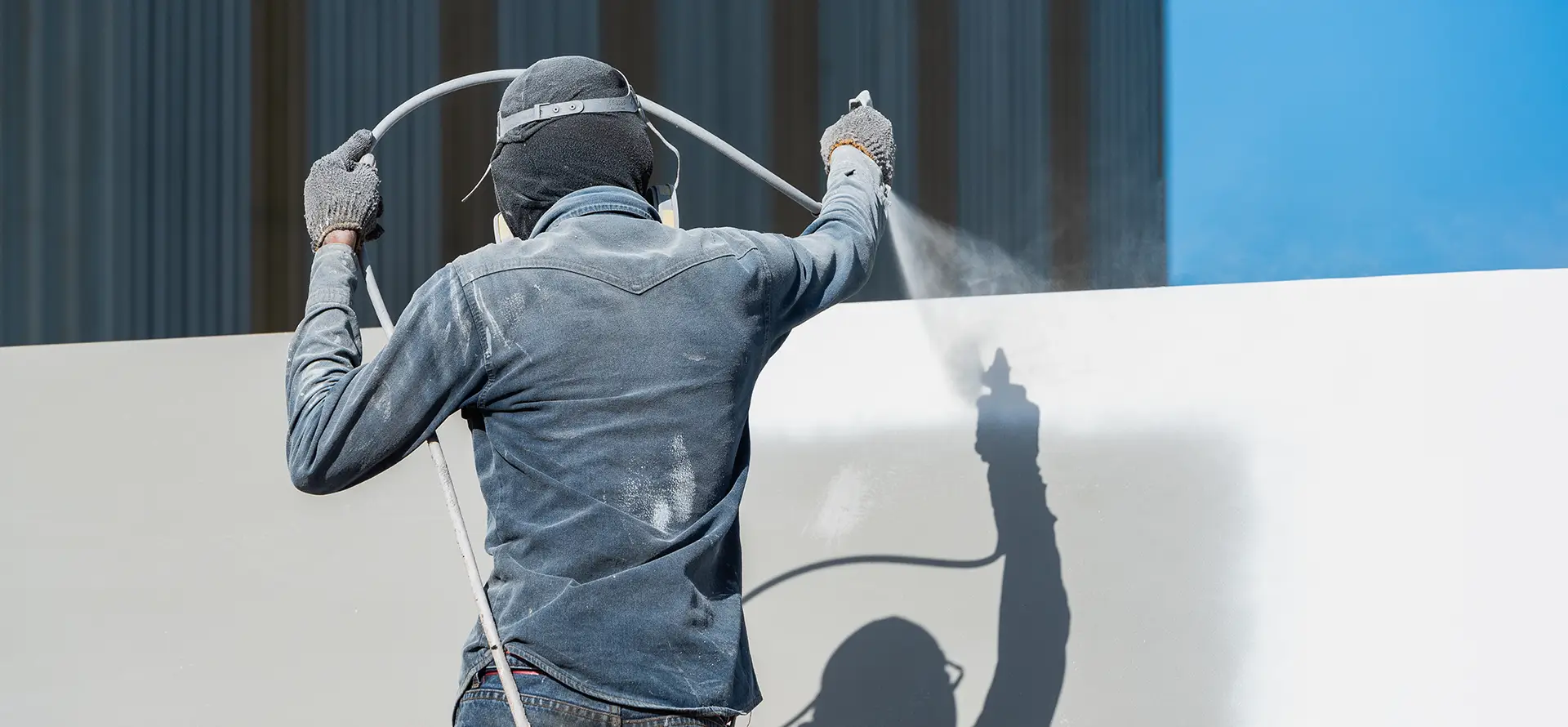
On façades, the goal is a uniform, controlled application. Work with regular passes, keeping a consistent overlap between one pass and the next to avoid coverage differences. The working distance should stay stable across the whole surface (roughly 30–40 cm, to be adjusted according to tip, pressure and substrate roughness). On edges, recesses and irregular areas, slow down and manage the spray angle to distribute the material evenly and avoid localised build-up.
Video: quartz paints and fillers with the Tecnover Superquindicimila airless pump
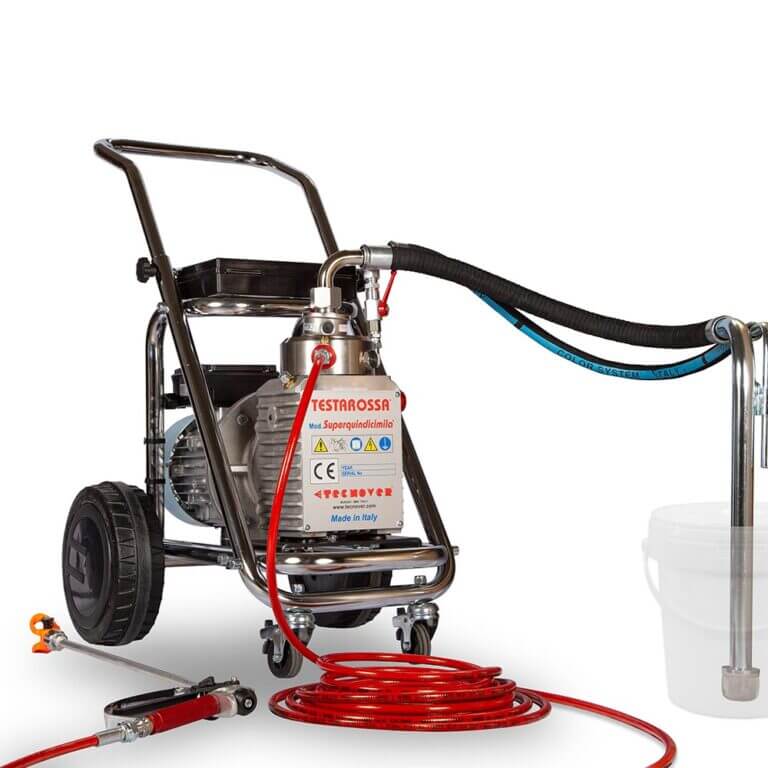
The video shows a Tecnover configuration ideal for working with dense materials in construction, including quartz paints and – with dedicated accessories – even spray fillers applied with the airless method. The machine works at a maximum pressure of 250 bar with a free flow of up to 13 l/min, parameters that help keep pace and continuity on large surfaces.
For quartz paints, one particularly relevant feature is the stainless steel pump head, designed to increase wear resistance when applying more abrasive products. The video also highlights the operational advantage of a delivery reach of up to 80 m, which reduces the need to move the pump when working on façades and exterior sites.
Real-world cases: applying exterior quartz paint with Tecnover airless pumps
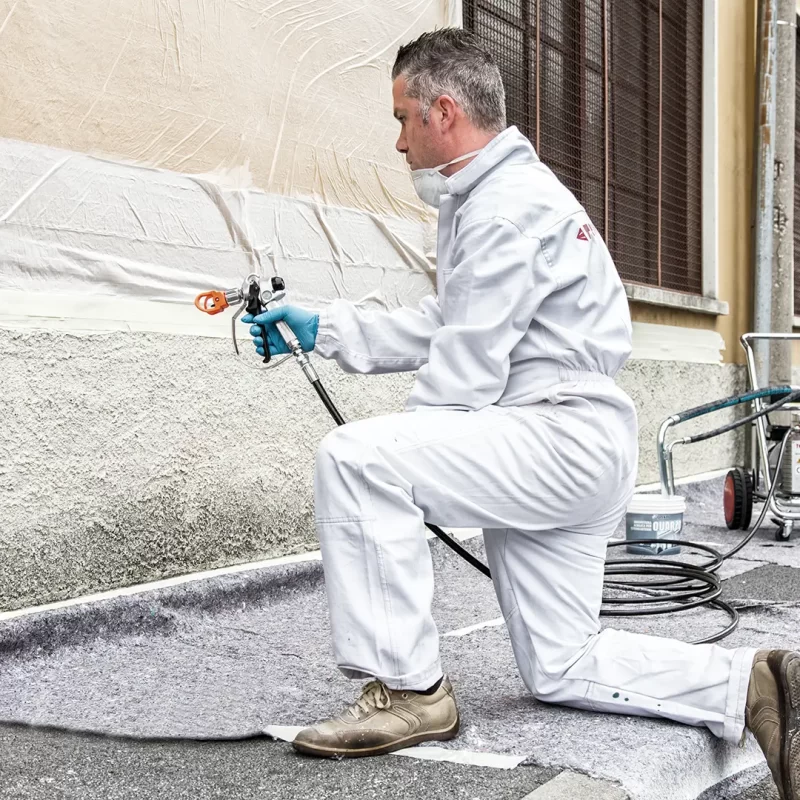
Case 1 – Application on a rough façade
Airless spraying on a rough façade.
- Material: exterior quartz paint
- Substrate: facciata/intonaco civile ruvido
- Pump: Testarossa Superquindicimila
- Tip: 0.025″ orifice
- Set-up: indicative pressure 180 bar + [30-mesh suction filter, 50-mesh gun handle filter]
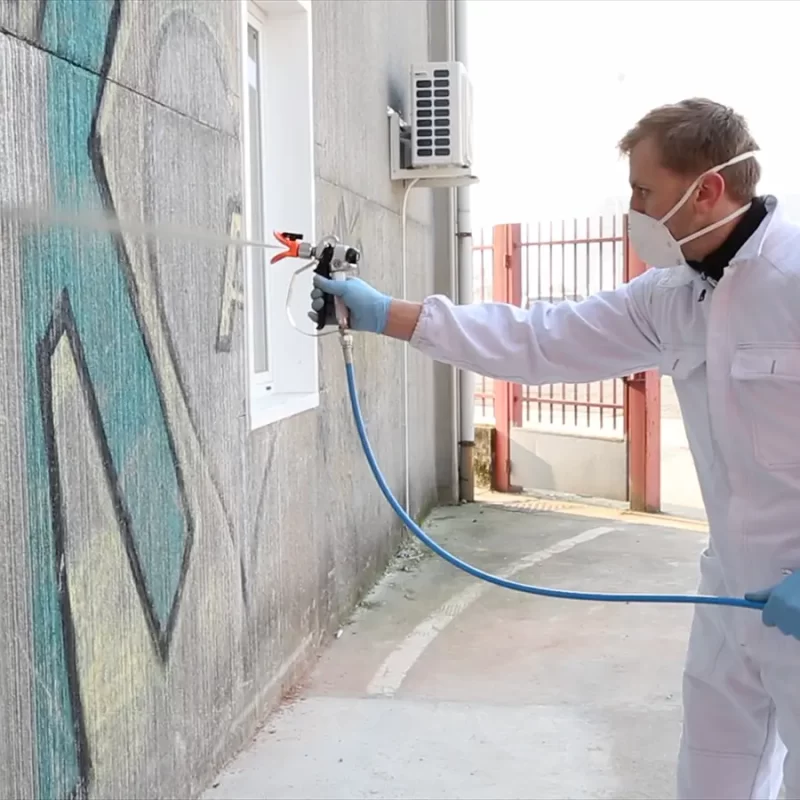
Case 2 – Large, continuous surface
Airless spraying on a large, continuous surface.
- Material: exterior quartz paint
- Substrate: exterior wall on civil render
- Pump: Testarossa Superdiecimila
- Tip: 0.027″ orifice
- Set-up: pressure approx. 200 bar + [15-mesh suction filter, 30-mesh gun handle filter]
Case 3 – Boundary wall
Spray painting of a boundary wall.
- Material: Quarzo Coat acrylic micro-coating for exterior and interior use by Colorificio Paulin, based on acrylic copolymers in water emulsion, ultra-fine quartz powders, micronised fillers and titanium dioxide.
- Pump: Testarossa Superquindicimila
- Tip: 0.023″ orifice
- Set-up: indicative pressure 180 bar + [30-mesh suction filter, 50-mesh gun handle filter]
Recommended Tecnover airless pumps for exterior quartz paint
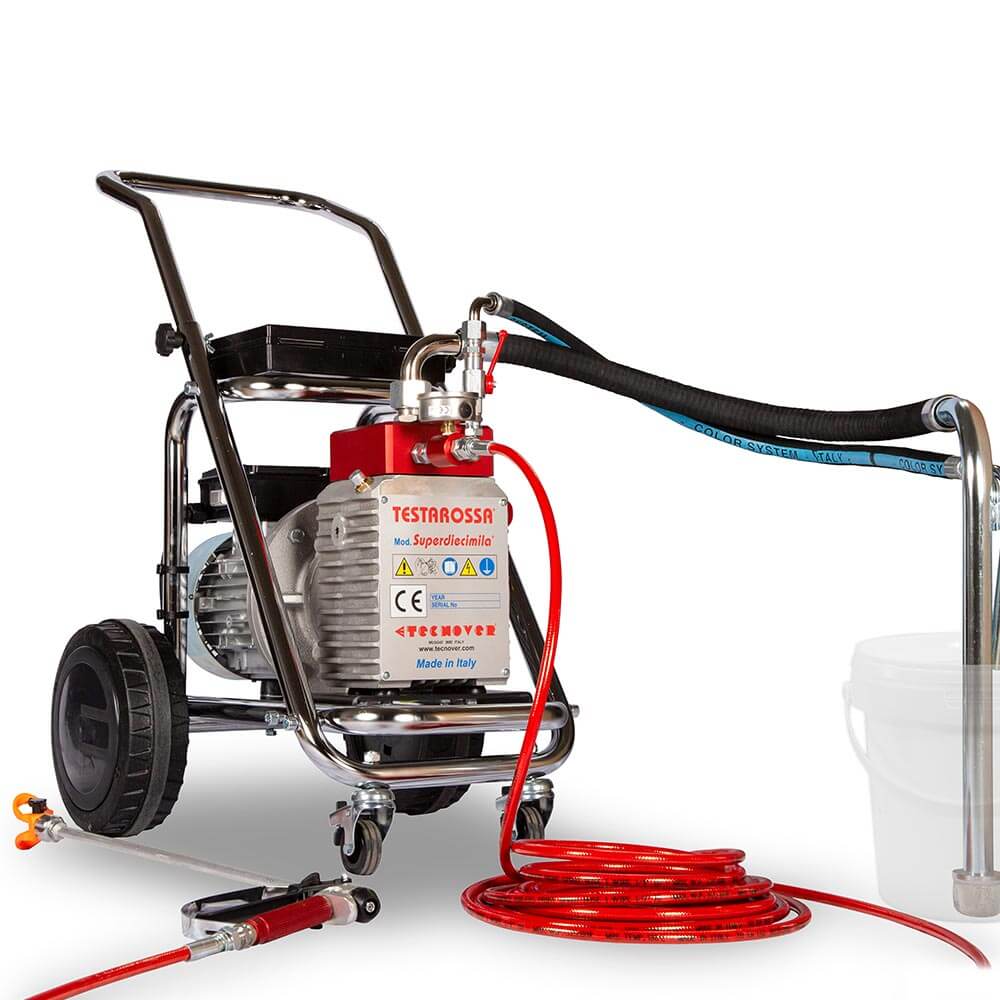
Testarossa Superdiecimila
The Tecnover Testarossa Superdiecimila airless pump is suited to medium and large surfaces where you need a powerful, versatile machine for exterior painting systems, including demanding substrates. It works at a maximum pressure of 230 bar with a free flow of 9 l/min and a maximum tip orifice of 0.041″: a setup capable of delivering productivity and operational continuity on site. It comes equipped with the Revolver Airless, which lets you rotate the spray fan with a simple flick during application.
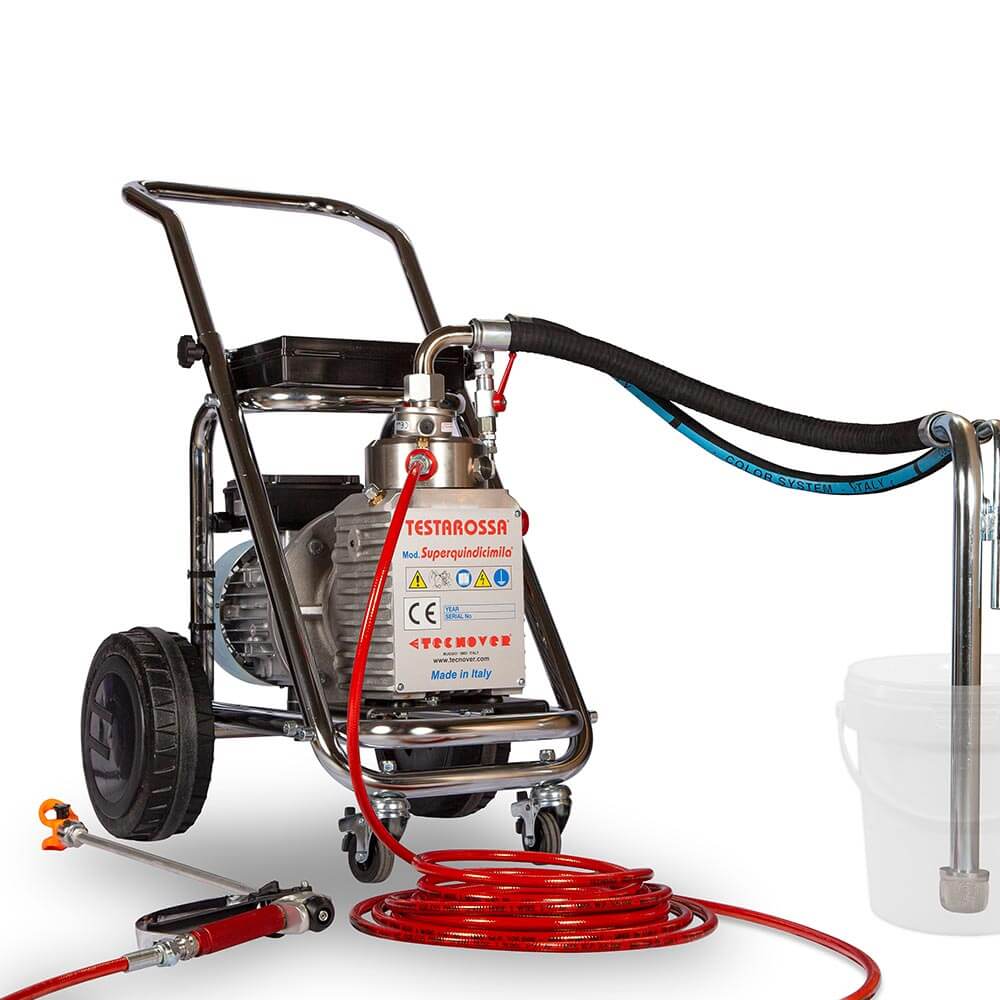
Testarossa Superquindicimila
The Tecnover Testarossa Superquindicimila airless pump is the recommended choice when the goal is to maximise productivity and continuity on large surfaces and intensive cycles, including exterior painting with quartz paints. The machine works at a maximum pressure of 250 bar, free flow of 13 l/min and maximum tip orifice of 0.045″ – parameters that support fast, consistent application on façades. This model is also equipped with the Revolver Airless.
Comparison table
The table below summarises the key features of the two Tecnover airless pump models recommended for exterior quartz paint. The parameters help you assess which machine best matches your site size, expected productivity and tip.
| Model | Max viscosity | Max pressure | Flow rate (free flow) | Max tip orifice | Recommended materials | Recommended applications |
|---|---|---|---|---|---|---|
| Testarossa Superdiecimila | 25.000 cPs | 230 bar | 9 l/min | 0,041″ | Exterior paints including filled products (e.g. quartz paint), painting systems on rough substrates | Façades and exterior walls • medium/large surfaces |
| Testarossa Superquindicimila | 38.000 cPs | 250 bar | 13 l/min | 0,045″ | Exterior quartz paints • dense construction materials (with appropriate setup) | Large surfaces • intensive cycles • façades |
To choose the most suitable Tecnover model and correctly configure accessories and consumables, contact us right away: we will help you assess your needs based on surface, material and site conditions.
FAQ – Frequently asked questions about applying quartz paints
What pressure is needed to spray quartz paint correctly?
For quartz paints, we suggest working at a pressure between 170 and 200 bar. This pressure range delivers effective atomisation of the material, ensuring good coverage even on rough surfaces.
How can I avoid lumps or pump clogging when spraying quartz paint?
Always filter the material before use, mix it thoroughly and keep the paint homogeneous in the drum. Check the viscosity and, if allowed by the manufacturer, dilute slightly. Adjust the pressure for a uniform spray, keep filters and tips clean, and clean the pump immediately after use to prevent product residues from hardening.
What precautions are needed when painting very rough exterior walls?
Prepare the substrate correctly (cleaning and repairs) and consider applying a primer/sealer first if absorption is irregular. Use a tip suited to the product’s texture and, if needed, work in several passes to even out coverage. Keep a constant distance (around 30–40 cm) and a regular overlap to avoid imperfections.
Is a piston or a diaphragm airless pump better for quartz paints?
For exterior construction work, Tecnover’s Superdiecimila and Superquindicimila airless pumps (both diaphragm models) are fully compatible with quartz paints, especially when you need operational continuity over long cycles and simpler equipment management. To find out which of the two models best suits your project, you can contact our experts at any time.
Which tip should I use for quartz paint on façades?
The choice of tip depends on the product’s particle size and the expected finish. As a working reference: 0.023″–0.025″ with fine particulate; for more heavily filled products, consider 0.027″. Also size the spray fan to the façade and run a test on a small area of the substrate to optimise pressure and coverage.
What role does filtration play with high-viscosity products?
Filtration is a key step in the process: it removes impurities and lumps, reduces clogging and protects the pump and tip, improving finish quality. Always use filters suited to the material (e.g. 30 or 50 mesh, depending on product and tip) and keep them regularly cleaned.
How often should I service/clean the equipment when spraying quartz paint?
The pump should be fully cleaned after every use: circuit, filters, tip and gun. Also check the filters and inspect wear-prone components at the end of each work session. Schedule more thorough maintenance every 100–200 operating hours, depending on intensity of use and the manufacturer’s guidelines.