In recent years, the use of “non-standard” materials has grown steadily on construction sites and in maintenance work: speciality paints for exterior façades, speciality interior paints with anti-condensation or thermal properties, high-resistance enamels, technical coatings, polyurethane coatings and much more.
In a nutshell, speciality paints can be defined as products that combine coverage and colour with an additional technical or aesthetic function, designed to meet specific requirements. That is why we speak of thermal paints, protective paints, decorative paints, washable paints, wear-resistant paints and so on. Compared with traditional emulsion paints, these formulations are often thicker in consistency, contain specific fillers or functional components and demand more controlled application. Viscosity, particle size and curing cycles also narrow the margin for error: if the application is not uniform, the defect shows immediately.
The quality of the equipment is essential to guarantee an optimal result, and choosing the right airless pump and setup (filtration, tip, pressure, spraying technique) is the key to working without interruption, maximising both output and finish precision.
Thermal paints, microspheres and cork: when control makes the difference
Thermal paint: what to expect?
Thermal paints are products developed to improve surface comfort and reduce common issues such as condensation and cold walls, especially where thermal bridges are present. A thermal paint for interiors is often the best choice for rooms prone to surface humidity, while a thermal paint for exteriors helps protect the façade and keeps the coating stable over time. When the main concern is surface moisture, another option is an anti-condensation thermal paint.
From an application standpoint, there is one golden rule: the product must be applied in a regular, uniform coat. If the speciality paint is laid down unevenly, the final effect will look imprecise and often forces touch-ups or a corrective second coat.
Microsphere paints: glass, ceramic and lightweight formulations
Many thermal or anti-condensation products rely on special micro-fillers in the formulation that modify the behaviour of the paint film. This is the case, for example, with microsphere paints (glass or ceramic).
During application, the coat of product must be distributed evenly across the surface, with a stable spray: the equipment must therefore guarantee continuous delivery, correct pressure adjustment and a spray tip compatible with both the product and the expected finish.
Cork paint: texture, film build and work pace
Cork paint (or cork-based thermal insulating paint) is a coating based on resins and cork granules/powder that, once applied, creates a textured, slightly elasticised finish. It is chosen when, beyond colour, you want a more substantial coat that helps improve surface comfort and protect the wall, especially on perimeter walls or exposed areas.
This speciality paint does not spread like a conventional product either: it typically requires greater film build and an extremely uniform distribution to avoid areas with inconsistent texture, build-up or visible “joins” between passes.
Quartz, enamels and polyurethane coatings: three families, three different requirements
Quartz paint: density and mineral fillers
Quartz paint is an exterior coating used mainly on façades because it delivers a tougher, “fuller” finish than many traditional emulsion paints. Its distinctive feature lies in its composition: it contains mineral micro-fillers (the quartz itself) that give the wall a more textured surface and improve resistance to wear and weathering.
Those very fillers, however, make the product denser and more demanding on the equipment during application. If the machine or the setup is inadequate, the most common risks increase: irregular flow, clogging, loss of productivity and a less uniform finish, especially on rough or porous substrates. To work well with quartz paints, it is therefore essential to have a suitable configuration and to pay attention to two key steps: mixing/preparing the material and filtration matched to the tip and the product being applied.
Enamels: finish, precision and spray control
Enamels are used to achieve tougher, more refined surfaces on wood and metal: doors, window frames, railings, interior elements, joinery and technical components. Compared with most wall paints, the goal here is a smooth, uniform finish, free of imperfections and variations in film thickness.
That is why enamel application is more sensitive to errors. Load on too much material or lose control of the spray, and runs, glossier/duller patches and small defects appear instantly – and are especially visible against the light. In these situations, an airless pump delivers stable, finely adjustable spraying: a correct setup (the right tip and pressure calibrated to the product) helps lay the enamel down evenly, maintaining excellent control and finish quality.
Polyurethane coatings: performance and application sensitivity
Polyurethane coatings are the protective coatings of choice when you need a finish tougher than standard: surfaces exposed to wear, humidity, frequent washing or contact with chemicals (typical of certain industrial settings and much maintenance work). In some cases these are high-performance products or more complex systems, including two-component (2K) formulations, where the final result depends heavily on correct application.
Here too, the goal is a uniform, continuous coat. If the film thickness varies too much from one area to another, or localised build-up occurs, defects can appear: uneven finish, inconsistent drying times and, in the worst cases, even problems with adhesion or long-term durability.
Why an airless pump is ideal for speciality paints too
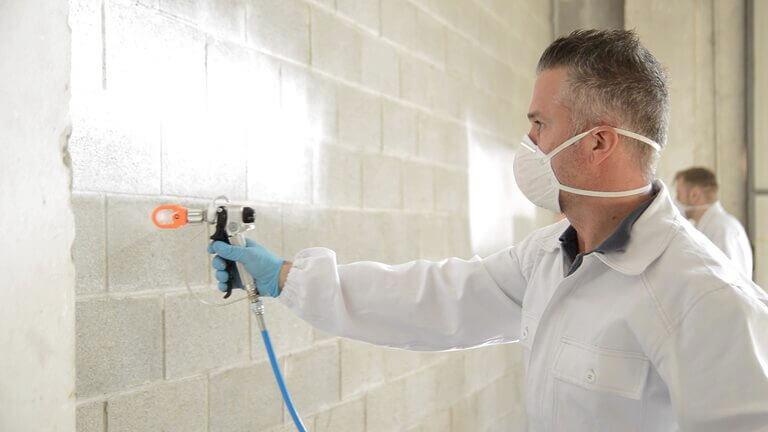
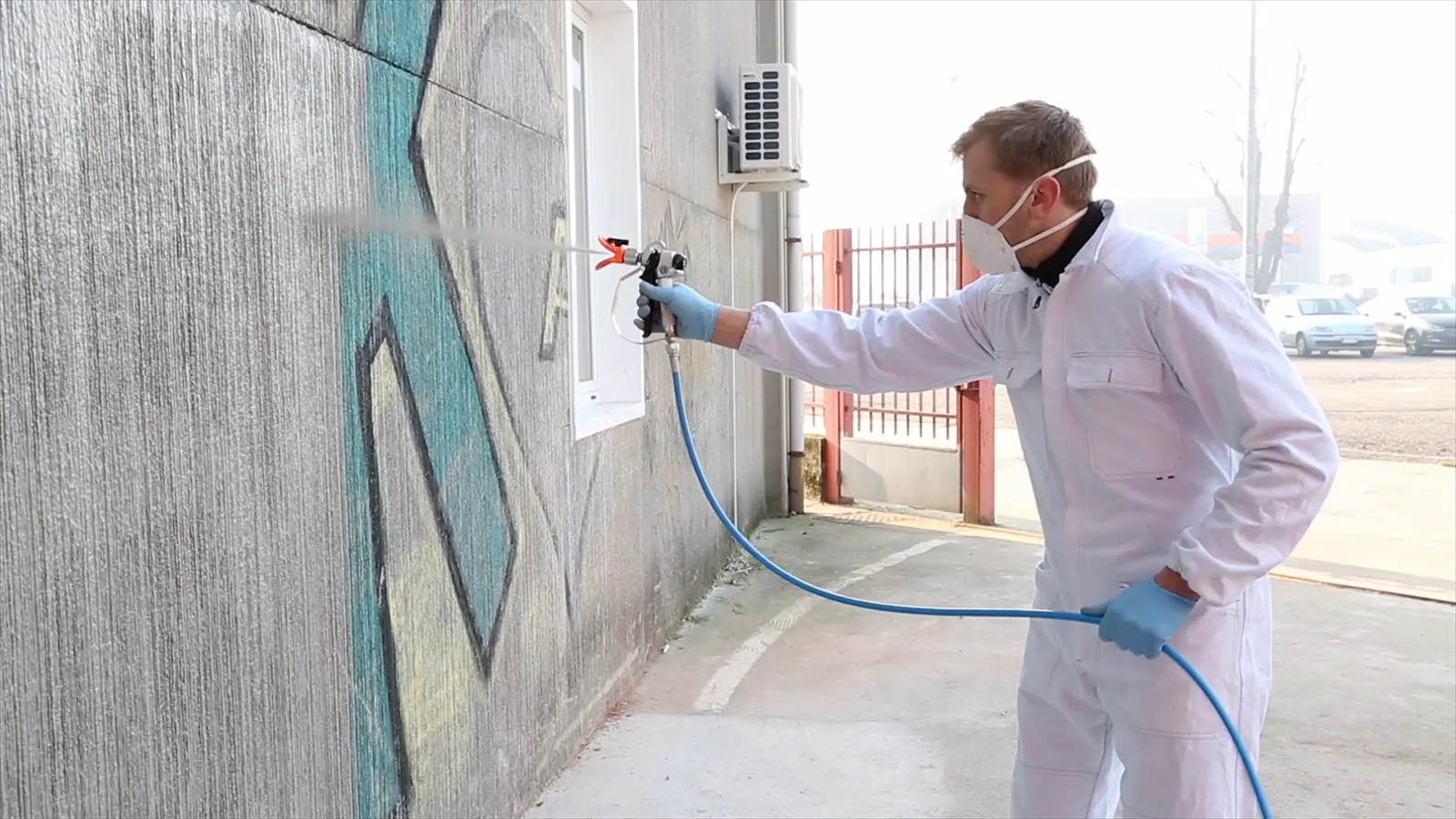
Airless technology atomises the material using hydraulic pressure alone: no compressed air is used to carry the paint. In practice, pressure and tip work together to determine how much paint is delivered, how wide the fan is and how finely the product is atomised. This is a decisive advantage because it makes the result far more controllable: when the pressure stays stable and the tip is correctly chosen, the spray is more uniform, continuous and predictable, even with “difficult” materials.
With speciality paints, the benefits are clear:
- Uniform application: even on irregular or textured surfaces such as façades, rough substrates or hard-to-reach areas.
- Higher productivity on large surfaces: less time lost compared with other application techniques, and therefore greater work continuity.
- Better film thickness control: essential with technical materials (thermal, anti-condensation, protective coatings).
- Less waste than conventional spray systems: thanks to more effective deposition on the substrate (with overspray reduced to almost zero when the setup and technique are correct).
Airless technology is, in short, the best available guarantee of a homogeneous, repeatable finish even with speciality paints, together with a significant reduction in interruptions and tedious subsequent corrections.
How to choose an airless pump based on the material to be sprayed
Choosing a professional airless pump should start from a practical question: “What material do I need to apply, and under what conditions?” An oversized machine can be awkward to manage; an undersized system risks drops in output, work stoppages and an irregular finish.
When selecting, focus on a few key parameters directly linked to on-site results: pressure stability, flow rate, maximum manageable tip orifice and the behaviour of the product (viscosity, fillers, particle size). Cross-referencing these factors with the surface to be treated and the required productivity makes it much easier to identify the right airless pump for the job.
Enamels and lighter finishes: Testarossa Superquattromila
When the aim is to work with enamels and less dense paints, a compact, precise machine is often the most rational choice.
The Testarossa Superquattromila is designed for use with enamels, paints, water-repellent impregnating agents and primers/sealers, thanks to a profile developed for “light” yet continuous professional applications. It is the typical solution when spray control, manoeuvrability and finish quality matter most – on interior surfaces or elements such as doors, frames and metal components.
Quartz, polyurethane resins and thermal insulating products: Testarossa Superdiecimila
The Testarossa Superdiecimila is Tecnover’s solution for applying quartz paints, polyurethane resins, epoxy finishes, intumescent and thermal insulating paints, when applied with the appropriate pressure, tip and filtration settings. The Superdiecimila’s specifications (maximum pressure 230 bar, free flow 9 l/min, maximum tip orifice 0.041″) make it compatible with construction sites, medium/large surfaces and more demanding materials.
Very dense materials and intensive cycles: Testarossa Superquindicimila
When product density, surface area and required work pace all increase, the Tecnover Testarossa Superquindicimila becomes the natural choice: it is engineered to deliver productivity and continuity on large surfaces, with a maximum pressure of 250 bar, free flow of 13 l/min and a maximum tip orifice of 0.045″.
When using higher-viscosity materials, it may be necessary to equip the pump with the 30-litre stainless steel gravity-feed hopper to make feeding easier and maintain continuity by exploiting gravity. It can also be useful to replace the standard hose with a larger-diameter ⅜″ high-pressure hose.
Best practices when applying speciality paints
- Substrate preparation: dust, uneven areas, chalking zones and irregular absorption compromise adhesion and uniformity. Before spraying, make the substrate stable and homogeneous (carrying out localised repairs and applying primer where needed).
- Thorough mixing of the material: if the product contains fillers, granules or functional additives, proper mixing is essential to reduce lump formation and keep output consistent between one refill and the next.
- Adequate filtration system: filtration protects the pump, hose and tip and contributes to a steady spray. To remove old residues or heavier particulates, pre-filtering with elastic filter socks is recommended.
- Tip and pressure: when applying speciality paints with airless pumps, the goal is not to run “flat out” all the time, but to achieve a stable spray fan and a uniform coat. In practice, the correct pressure is the one that atomises the product well without excessive misting or build-up.
- Spraying technique: consistent distance, straight passes and precise overlap reduce finish variations. On edges, recesses and critical areas, always slow down and manage the spray angle to avoid build-up.
- Immediate cleaning of the equipment at the end of the job: especially with technical products, cleaning cannot be postponed. The fluid circuit, filters and tip must be cleaned immediately after finishing, and in the correct manner, to prevent residues and blockages and preserve the equipment’s performance.
Tecnover: the professional airless pump specialist, even for speciality paints
With speciality wall paints, enamels, quartz, thermal products or polyurethane coatings, the result comes from the whole system: a professional airless pump matched to the material, the right accessories (filters, hose, tip), a correct setup and skill in the spraying technique. When these elements work in synergy, operational continuity and finish quality rise, while stoppages, rework and visible defects fall.
If you are wondering which airless pump to use with quartz paints, enamels, thermal paints or polyurethane systems, Tecnover is at your disposal for targeted technical support: we will help you identify the right solution and correctly configure the machine, consumables and working setup.
Contact us today!